

House Speaker Jon Patterson says the intent is to exempt fuel and the bill — which would allow sales tax on ‘any goods and services’ — will be changed so there is no new tax on fill-ups
BY: RUDI KELLER
Missouri Independent
The latest version of a proposal meant to implement the governor’s income tax cut could also trigger a first for Missouri: sales taxes on gasoline and diesel, a result the bill’s sponsor says was accidental.
Under the terms of the proposed constitutional amendment sponsored by House Speaker Jon Patterson, sales tax could be imposed “on transactions involving any goods and services” and the revenue would be exempt from the prohibition on using money generated from a tax on fuel sales for state needs other than highways.
Missouri has earmarked money from taxes on motor fuels for highways since 1928.
That is not the intent, Patterson said in an interview with The Independent on Thursday, the day after he filed a revised version of the proposal that fixes earlier errors and expands on limitations intended to prevent a windfall of new revenue for state and local governments.
“There is absolutely zero intention on my part to see any increase in the motor fuel tax,” Patterson said.
An amendment to his bill will be prepared to make that explicit, Patterson said. The reference to how taxes on motor fuels are used is intended to prevent a new sales tax on fuel, Patterson said, not to divert money from highways.
“The purpose of that whole paragraph is to say, ‘no, the motor fuel tax is not part of this,’” Patterson said.
Gov. Mike Kehoe, in a brief interview, declined to comment on imposing sales tax on fuel. He said he had not read Patterson’s proposal.
Missourians, who would have to vote on Patterson’s proposal, don’t want to pay more for gasoline, said Senate Minority Leader Doug Beck, a Democrat from Affton, at his weekly news conference.
“They’re going to be upset,” Beck said. “I think they’re going to be upset because there’s a lot of this.”
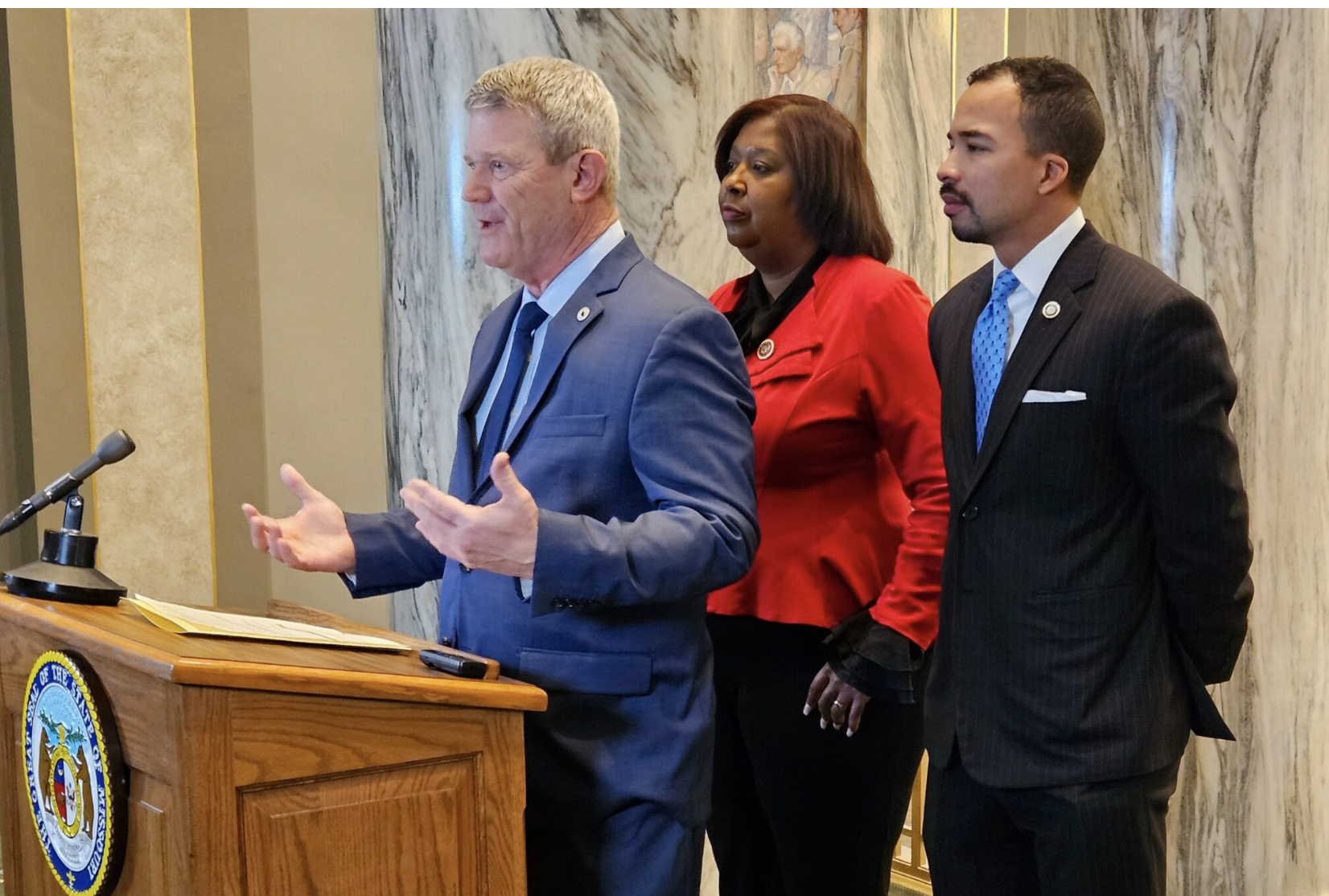
Kehoe and Republicans who control the General Assembly have made eliminating the state income tax on individuals their top priority for the year. Patterson’s proposal, which is expected to receive a public hearing next week, does not specify a sales tax rate to replace the income tax.
Missouri currently charges 4.225% on taxable goods other than food from groceries and vending machines. Of that, 3% is for general revenue, generating about one-fifth of the $13.4 billion in general revenue collected in the most recent fiscal year.
Local sales tax can double or almost triple the basic state rate.
The version filed Wednesday is Patterson’s second attempt. A constitutional amendment he filed last week had a drafting error that misstated which article contains the limit on the use of highway funds.
Patterson’s new proposal asks voters to grant lawmakers broad authority to expand sales tax to currently untaxed goods and services. Services such as accounting fees for tax preparation or car repairs are not currently taxed, and goods currently exempt include prescription drugs and home utilities.
In his State of the State Address, Kehoe said he wants to target “monthly subscriptions and digital services like online advertising, e-books and AI platforms that fall outside our current sales tax base.”
Lawmakers are also authorized by Patterson’s proposed amendment to set revenue triggers that would reduce, and then eliminate, the individual income tax as early as Jan. 1, 2031.
Other provisions would:
- Exempt the tax legislation implementing the proposal from revenue lids that require tax increases to be submitted to voters.
- Require local governments to adjust local tax rates downward to offset any increase in revenue from the broader sales tax base.
- Reduce the constitutionally imposed sales taxes for conservation and state parks and soil conservation, 0.225% total, to make revenue from the new tax base equal the average of recent years.
- Keep in place income taxes on corporations and other businesses, as well as allow income taxes on estates and trusts.
The exact list of things to be taxed, and the rate needed to replace current revenue, will be decided later, if voters approve his amendment, Patterson said.
“The people and their elected representatives will come together and decide, No.1, if they even want to do this, and if they do how they’re going to do it,” Patterson said. “But it’ll be the people and their elected representatives doing it together.”
Asking voters to trust Republican leaders to get the details right is irresponsible, Beck said. The GOP has rushed and made mistakes on tax cuts, congressional district maps and state budget estimates, he added.
When a bill eliminating the income tax on capital gains passed last year, it carried an estimated price tag of about $160 million in the current fiscal year and ongoing cost of $111 million The actual revenue cut is about $500 million in the current year and $350 million annually.
The mistake in state budget estimates was a $250 million math error in the forecast for how much the state would have on hand at the end of June 2027.
“The whole tax scheme in general, I’m just going to be honest with you, is ill conceived,” Beck said.
Missouri’s two largest population centers are on the state’s border and people who can shift purchases over the state line to avoid taxes will do so, Beck said.
“I don’t see this as an economic driver for the state,” Beck said. “I don’t see this as helping anything.”
Gasoline prices are one of the most visible barometers of the economy, rising after disruptions or when there is high sustained demand and falling when supplies are plentiful or purchases fall off in a recession.
Missouri fuel taxes have increased 12.5 cents per gallon since Oct. 1, 2021, and stand at 29.5 cents a gallon.
Missourians consume about 4.1 billion gallons each year, generating approximately $1.2 billion in highway revenue.
That fuel, if sold at $2.50 per gallon, would generate about $435 million if subject to the the current state sales tax. The price of a 15-gallon fill-up would increase from $37.50 to $39.10.
Republicans have been cutting state income tax rates since 2014, when the top rate stood at 6% for taxable incomes greater than $9,000. The top rate is now 4.7%. Two future cuts, bringing the rate down to 4.5%, are already on the books and will take effect if general revenue growth hits certain targets.
Missouri collected $9.2 billion from the individual income tax before refunds in fiscal 2025. Generating the same revenue on the current sales tax base would require an additional sales tax of about 8.5%.
Those funds pay for public schools, prisons and medical care for more than 1.3 million people, among other state services.
The goal, Patterson said, is to replace a tax structure put in place in the 1920s and 1930s with one that fits modern economic activity.
“It really needs to be modernized,” Patterson said. “And this is something that you’re seeing, not just in red states or blue states. A lot of states are looking at modernizing their tax system.”
The lack of details on what will — and what won’t — be taxed is a big problem, Beck said.
“They’re taking (income tax) away,” Beck said, “and they’re saying the legislature knows better than the people, just like they’ve done in the past.”