


BY: REBECCA RIVAS
Missouri Independent
At least seven marijuana cultivation facilities in Missouri have been fined over the last year for breaking what’s known in the industry as the “immaculate conception rule.”
Marijuana can’t pass over state lines because it’s still federally illegal, and state law mandates that all marijuana must be grown within the state.
However, there is one year after a licensee passes a commencement inspection when the state essentially closes its eyes and puts its hands over its ears on how a cultivation facility starts its inventory.
It’s called the immaculate conception rule, and six facilities were fined up to $500,000 from breaking it last year.
A spokesperson for the Missouri Division of Cannabis Regulation said regulators “discovered some licensees believed they were permitted to bring in clones or tissue cultures as well as seeds on an ongoing basis. However, this practice is a violation of seed-to-sale tracking regulations.”
To keep up with customers’ preferences and demand, these companies had been bringing in clones, or starter plants, and tissue cultures, which is a form of in-vitro propagation, of popular plant varieties from other states
“In lieu of penalties or other enforcement action, these violations were resolved for amounts ranging from $50,000 to $500,000, depending on the circumstances,” said Lisa Cox, spokeswoman for the Missouri Department of Health and Senior Services, which oversees the cannabis regulation division.
The licensees that saw the biggest fines are major players in other states as well, including the companies behind Good Day Farm and High Profile.
The combined fee for four cultivation licenses representing Good Day Farm and Codes, which share management, was $347,495. The facilities are located in Columbia, Carrollton and Chaffee.
For High Profile, it was $500,000 at its O’Fallon cultivation facility.
Two smaller cultivators also saw fines of $20,000 and $50,000.
None of the licensees who were fined by the state returned The Independent’s request for comment.
The ‘mother plant’
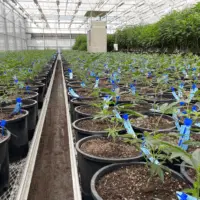
Cultivation facilities in Missouri are approved to grow marijuana plants, and the harvest is sent to a manufacturing facility that then makes pre-rolls, edibles and other products.
Oftentimes, cultivators will develop “a mother plant” to collect clones, or cuttings, from the plant and put those into their own pots. Those are genetically identical to the plant that they’re cut from.
But where does the mother plant come from?
For a facility’s first year, the “rules and law are silent on how that occurs,” Cox said.
After that, the facilities can ask the state for permission to bring in seeds for “ongoing inventory needs,” she said, or get clones from other licensed cultivators located in Missouri.
But the state fined several licensees last year for not sticking to those rules, sending a clear message to all Missouri companies that they have to grow plants from seed or get starter plants from their competitors.
Ryan Schepers, instructor for St. Louis Community College’s cannabis program, said as a “plant nerd,” he doesn’t believe starting from seed is a necessarily difficult thing — or a bad thing for the industry’s innovation.
“I think a lot of the cultivation centers are set up to care for already established plants, and that would be a little bit of a challenge,” he said.
But it’s nothing the “well versed” plant growers working in the cultivation centers can’t handle, he said. The main challenge is the delay in production, he said. It will take about a month to six weeks for a cannabis plant to start to be well established, he said, but they’ll be “pretty hardy plants.”
“Clones are obviously much easier to deal with,” he said.
But tissue cultures involve a small amount of cells to get started, he said, and that process can take about as long as seed sprouting.
He understands that it’s difficult for companies to align the plant growth time with the need to keep up with trends in other states. If a product is selling really well in California, he said, “of course we’re going to try to get that same thing in Missouri.”
However, he said it can disincentivize cultivation centers from trying new things. For the sake of his students, he hopes the emphasis will shift to breeding and innovation.
“We, at St Louis Community College, really emphasize that our students be plant scientists who focus on cannabis,” he said.
Innovation can be difficult when the federal and state laws are rapidly changing, he added.
The Independent asked if the state would consider a variance for licensees to get clones in the future to keep up with popular varieties.
“The department was considering guidance from the DEA that indicated clones may no longer be considered marijuana under federal law due to low Delta 9 [THC] concentrations,” Cox said.
However, she said recent changes to federal law “may change the status of seeds and clones.” She was referring to restrictions on hemp that were passed as part of the federal spending package last year and will be effective in November.
“So the department will need to follow how federal guidance,” Cox said, “and interpretation develops over the next year before it makes any changes to rules or processes.”